Publishers
Addition by Subtraction: Transform Your Content Recommendation Strategy
Megan Rhein
Updated On:
April 7, 2026
LAUNCH YOUR FIRST REVCONTENT CAMPAIGN TODAY
Sign Up
Get in touch with our team
Contact Us.png)
For most publishers, monetization has traditionally been about adding more — more demand partners, more scripts, more optimization layers. But in today’s performance-driven ecosystem, growth doesn’t come from adding more weight. It comes from removing it and adopting lightweight ad tech that prioritizes speed, efficiency, and user experience from the start.
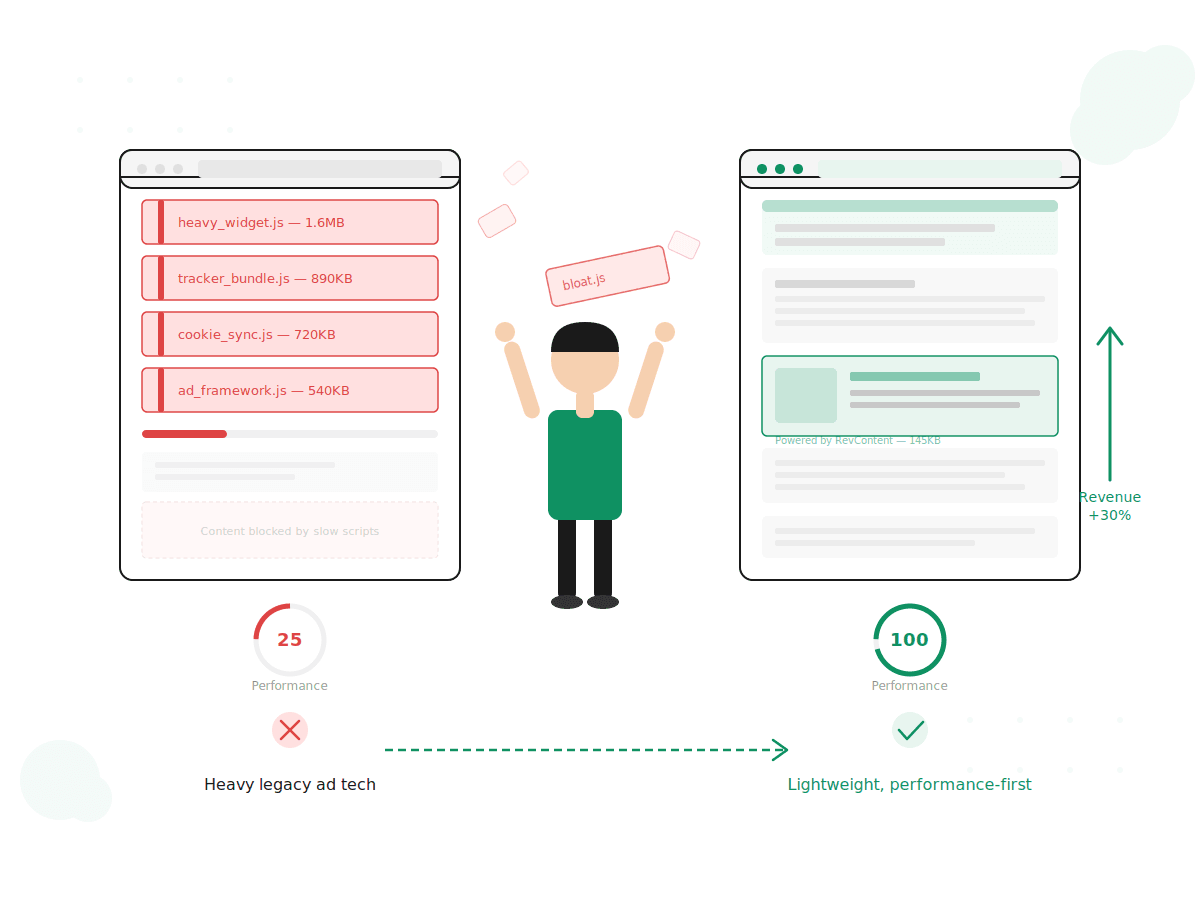
This is the principle of “addition by subtraction.” By replacing a heavy, legacy content recommendation widget with a lightweight ad tech alternative, publishers can simultaneously improve page speed, Core Web Vitals, SEO performance, user experience, and revenue.
And the impact isn’t incremental — it’s compounding.
What Happens When Publishers Prioritize Performance
The connection between page speed and revenue is no longer theoretical. It’s measurable across industries.
Case Studies: Performance Optimization Drives Monetization
RevContent
RevContent recently partnered with a top news publisher that had a longstanding relationship with a top competitor. As part of the transition, the focus was on eliminating reseller pathways and simplifying their ads.txt strategy to create a more direct and efficient monetization approach.
By reducing intermediaries and strengthening direct SSP relationships, the publisher was able to enhance the value of their inventory, improve partner performance, and minimize inefficiencies across the ecosystem. The impact was immediate and significant: total page CPM increased by nearly 30%, resulting in a meaningful lift in overall advertising revenue — demonstrating how strategic partner consolidation can drive both immediate gains and long-term monetization improvements
Netzwelt
When Netzwelt, a major German publisher, rebuilt its site with a focus on Core Web Vitals and ad delivery optimization, the results were significant:
- 18% increase in ad revenue
- 20–30% lift in CPMs
- 75%+ ad viewability (vs. <50% global average)
- 50% reduction in bounce rate
- 27% increase in page views
Adnimation
In another example, a large tech publisher saw revenue decline by 16% despite adding 1.2 million more visits (approximately 15 million pageviews) over a six-month period — a clear signal that traffic alone wasn’t the issue. Instead, inefficiencies within their ad stack were limiting their ability to convert that audience into revenue.
After transitioning to a more performance-focused, lightweight ad tech solution, the impact was immediate. Within just two weeks:
- Revenue doubled compared to their previous provider
- Site speed and overall user experience improved
- Monetization efficiency increased, unlocking significantly more value from existing traffic
As the publisher put it, “speed was probably 90% of the reason I left.”
This is the “addition by subtraction” effect in action. By removing a heavy, performance-limiting partner and replacing it with a more efficient solution, the publisher didn’t need more traffic to grow — they simply unlocked the full revenue potential of the traffic they already had.
The Hidden Cost of Legacy Ad Tech vs. Lightweight Ad Tech
Many content recommendation platforms position themselves as easy revenue drivers. But what’s often overlooked is their true cost to site performance. Heavy, legacy platforms often rely on bloated code, while lightweight ad tech is designed to minimize performance impact from the start.
Heavy ad tech typically:
- Adds large JavaScript payloads
- Triggers hundreds of network requests
- Competes for browser resources
- Delays rendering and interactivity
In fact, industry research shows:
- The average ad script can weigh up to 1.6MB and trigger 300+ requests
- Third-party scripts account for 40–70% of Core Web Vitals degradation
What looks like a monetization solution can quickly become a growth constraint – with slower pages driving higher bounce rates, fewer impressions, lower revenue, and declining search visibility.
The Revenue Flywheel: Why Lightweight Ad Tech Wins
When publishers adopt lightweight ad tech and performance-first technology, the benefits don’t happen in isolation. They compound into a self-reinforcing growth cycle:
Faster pages → Better Core Web Vitals → Higher rankings → More traffic → Lower bounce rates → Higher viewability → Increased CPMs → More revenue
The impact at each stage of this cycle is well documented:
- A 1-second delay can reduce conversions by up to 7%
- According to Google, 53% of users abandon sites that take longer than 3 seconds to load
- Improving LCP by 40% has been linked to 28% more organic traffic
At the same time, the shift toward privacy-first, cookieless solutions is accelerating this advantage. By reducing reliance on heavy tracking infrastructure, lightweight solutions naturally:
- Minimize script overhead
- Reduce network requests
- Improve load times and responsiveness
The result is a faster, cleaner user experience that drives stronger engagement and monetization outcomes.
Making the Switch: What to Evaluate
Switching content recommendation partners is one of the most impactful — and often underutilized — levers publishers have. Here’s what to prioritize:
1. Performance Impact
- Does the widget load asynchronously?
- Does it avoid blocking the main thread?
- How does it affect LCP, INP, and CLS?
2. Code Efficiency
- What is the total script weight?
- How many network requests are triggered?
- Is lazy loading implemented effectively?
3. Revenue Alignment
- Does better performance lead to better monetization?
- Is revenue driven by user experience — not at its expense?
4. Future-Proofing
- Is the solution cookieless?
- Will it support evolving Core Web Vitals standards?
The key mindset shift: this isn’t just a vendor change — it’s a site-wide performance upgrade.
A Smarter Growth Strategy
For years, publishers have been told that more technology equals more revenue. But the data shows the opposite.
Publishers seeing the strongest results today are the ones simplifying their stacks, reducing latency, and prioritizing performance at every layer.
Because sometimes, the fastest way to grow isn’t to add more. It’s to remove what’s holding you back.
That’s the power of addition by subtraction — and it’s redefining how modern publishers approach monetization, SEO, and long-term growth.
If you’re ready to see what a lighter, faster lightweight ad tech stack can unlock for your business, reach out to our team at RevContent to learn more.


.png)